MC6883: The Secret Standard
Motorola has done some fairly interesting things in the world of computing history, despite being overshadowed by Zilog and MOS in the 8-bit era. Their 68000 CPU line is obviously one of my all-time favorites, powering many iconic computers from the mid-80s onwards. However in this episode, we will be looking at a somewhat obscure yet highly impactful thing they made that shaped quite a bit of historical systems. And that is the, uhm... the data sheet for the Motorola MC6883 Synchronous Address Multiplexer.
![[SFX CUE: CRICKETS]](https://junks.holenet.info/EY004_joke_675.png)
I swear this is more interesting than it sounds.
EDUCATION
YOURSELF
Episode 004
Part 1: Future Farming Flop
In 1977, the University of Kentucky College of Agriculture decided to do an experiment based on a technology trend over in Europe. Over there, people were getting information via Videotex systems, which allowed people to get information in text format from a live service for things like news, weather, and so on, using a special terminal system. Information like weather is critical for the agricultural industry, and having a near-instant means to get this would be a huge boon. So, Motorola and Tandy were selected for the "Green Thumb" project: create a low-cost Videotex platform to provide to farmers, ranchers, and the rest of the agricultural industry, so they can get the info they needed for operating their farms more effectively and easily.
By 1978, a prototype was finished that used the MC6847 Video Display Generator along with Motorola's answer to the 6502: the Motorola 6809 microprocessor. However, it needed a crapload of extra logic chips to be functional, so it wouldn't be cheap. Motorola thus combined all of this logic into a single chip: the MC6883. With this, the price goal could be met, and Tandy was able to create the TRS-80 VideoTex Terminal for 1980.
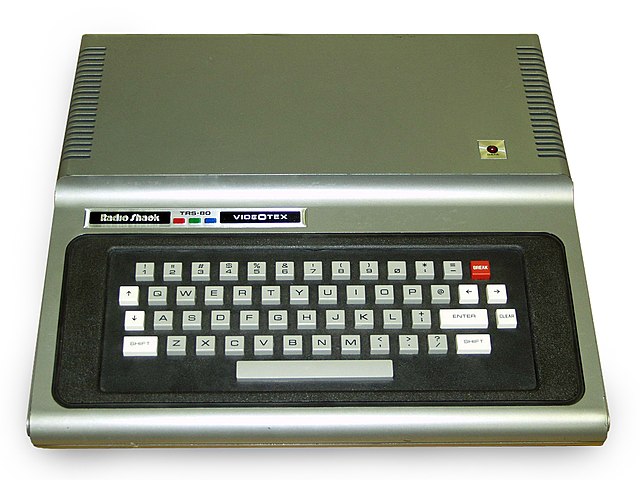
It flopped. Perhaps the farming industry wasn't tech-savvy enough to be interested? Or perhaps it was just too far ahead of its time? Or maybe, they knew what kind of bullshit was in store for them?
In any case, the MC6883 was released as part of Motorola's product line of support chips. The entire datasheet in question can be obtained here from archive.org. What is most notable here is pages 23 and 24. These are schematics for the majority of the VideoTex Terminal! This was provided to developers as a baseline reference for their own designs, but it's pretty powerful as it is. In fact, this should be enough to create a fairly compelling microcomputer system...
Part 2: Tandy Recycles
Tandy's main microcomputer offering, the TRS-80, was getting its ass kicked by Commodore's VIC-20 and Atari's 8-bit computing lineup. These computers offered color graphics and were capable of high quality gaming experiences, something the one-bit text-only TRS-80 just could not do. Tandy desperately needed something... but they already had it. The VideoTex Terminals! They could be easily modified into a comparable system and offered at a low cost. And that is exactly what they did. The internal modem was removed, the needed I/O ports were added, a slot was cut in the case for addons and ROM carts, and they got those BASIC guys to make a version of BASIC for the CPU. And with a cheeky memory size sticker to cover the modem light and a new badge...
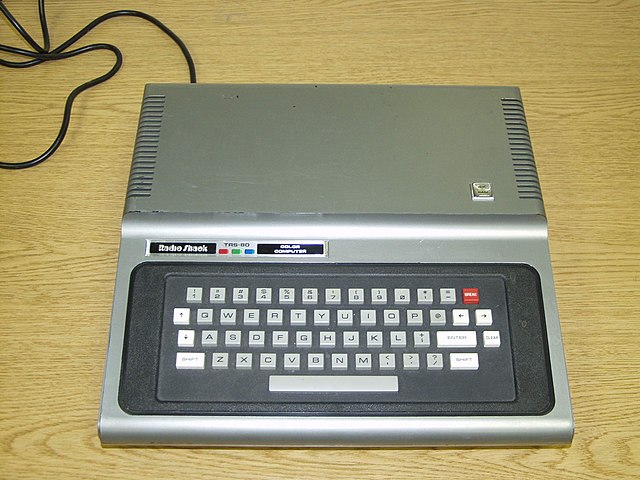
...the Tandy Color Computer was born! The initial base model only had 4K RAM, with other models having 16K, 32K, and 64K RAM; the 4K and 32K models were eventually dropped, as a motherboard revision made the 4K configuration obsolete and improved RAM chip yields meant that Tandy didn't have any more "half-bad" 64Kx1 chips to make 32K configurations with. Despite having only a base clock speed of 895 KILOHERTS, this machine was well-loved by many and has an active user group scene even to this day. The computer got updated offerings with better ROMs, lowercase support, and even a clock speed boost with the ability to have up to a whopping 512K of RAM and even get a UNIX-esque operating system! But those latter systems also dropped the MC6883 for more advanced technology, so they're out of the scope for this episode.
You know what isn't out of scope? Scalies. Wait lemme try that again.
Part 3: Dragons, Here They Be
Meanwhile in Wales, a new company called Dragon Data was formed in 1982 by an obscure toy company called Mettoy. They planned to make an affordable microcomputer for the European market, and were most interested with the MC6883 reference. So they took this design, made a few tweaks (like a different keyboard mapping, and using parallel for the printer instead of serial), got a license from those BASIC guys, and created...
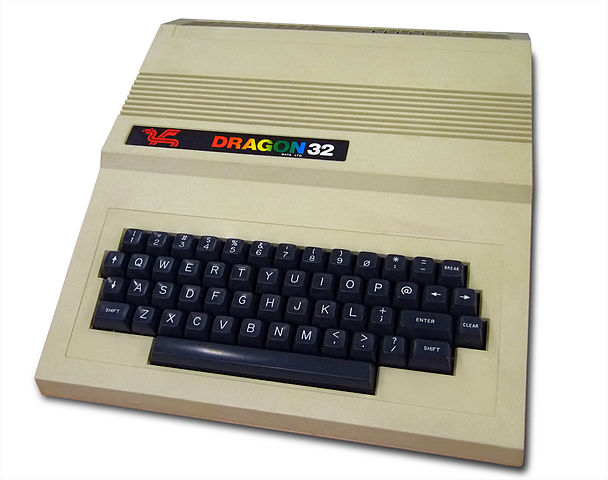
...the Dragon 32, named for its 32K of RAM. A year later, it was immediately followed up with the Dragon 64, which increased the RAM to 64K and brought back the missing serial port. And yet, it flopped. There was nothing they could do about the impenetrable dominance of Sinclair, Acorn, and Commodore in the region. They were bought up in 1984 by a Spanish startup named... Eurohard?! They tried to resurrect the line and branding, which involved developing an MSX-compatible microcomputer with the help of... RADOFIN?! What are you doing here?! Well, nothing actually got far off the ground as Eurohard was liquidated in 1987.
However, most people say that the Dragon 32/64 was a clone of the Color Computer, or even that they ripped them off. The truth is... they were both just using the same reference design. Identical core components in roughly the same layout, plus the same operating software, results in a similar computer. And the design isn't exactly owned by any one entity, it's a reference design that's freely available for anyone to use. This makes it more like a standardized platform than anything else.
In fact, there were several similar systems produced in Brazil! There's the Prológica CP 400 Color (and the CP 400 Color II), the Varix VC 50, the LZ Color 64, the Dynacom MX-1600, and the Codimex CD-6809. In Mexico, the Micro-SEP was promoted by the Secretary of Education for use in computer literacy in schools. And in Taiwan, Sampo created the Sampo Color Computer for the Asian region. All of these used the same reference design as the CoCo and the Dragon. This was a computing platform standard, though nobody ever noticed it was one.
Special Thanks
Massive shoutouts to Ike Adibe for the mini-comic in the intro! It was the only way for that joke to work properly. You should check out his stuff and maybe even give him a commission!
NEXT TIME ON EDUCATION YOURSELF
If you thought this was the only story I had that involved Tandy, Motorola, a flop-turned-success, Europe, and an art commission... you'd be wrong.